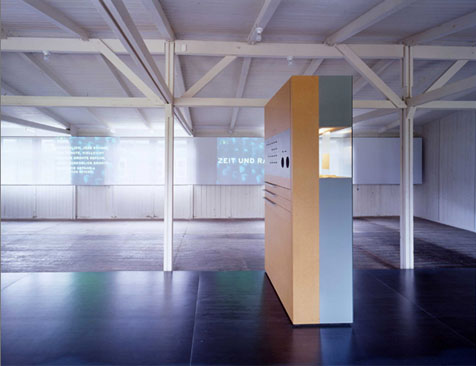
The exhibition is built around the (subjective) perspectives of the ex-prisoners and prisoners' narratives are related to camp exhibits in every section of the exhibition. Visitors can also listen to recordings made by the prisoners, helping to bring the exhibits to life, by relating them directly to the extreme situations of the concentration camp and ensuring that exhibits are presented clearly and convincingly.
The small number of exhibits, in total 120, and the reserved style of Prof. H.G. Merz's exhibition preserve the barracks, which were reconstructed from original pieces in 1961, as the main exhibit. The 600m² exhibition is complemented by a CD-ROM which is available for visitors to use on two computer work-stations. The exhibition itself was designed to present far more than just a simple continuation of prisoner biographies. For this reason the CD-ROM is there to enable visitors to learn much more about individual prisoners than the museum could present within this exhibition's framework.
to Sachsenhausen
Between 1936 and 1945, the reasons the prisoners were arrested and the way in which they arrived in Sachsenhausen was often very different. In the first years, political and ideological opponents from within Germany were sent to Sachsenhausen but this was soon to change as the war began and tens of thousands of people from the occupied countries followed.
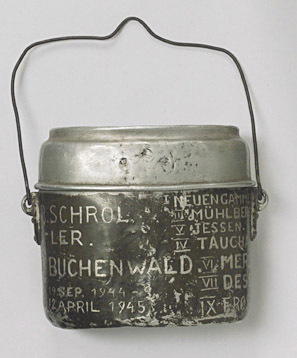
Birger Schroller, a Danish prisoner held in Sachsenhausen swapped cigarettes for this billy can with an unknown Soviet prisoner of war. The numerous previous owners have inscribed their place of arrest into its sides and the names of all the concentration camps have been arranged into the form of the galaxy.
The treatment of concentration camp prisoners by the SS was aligned with the National Socialist world view. For these reasons the fact that a prisoner was a German political prisoner or for example Jewish, Russian or homosexual, was of fundamental importance. This part of the exhibition shows how the SS treated the different categories of prisoners and the often brutal hierarchies or "the most extreme class system" (Primo Levi), that existed between the prisoners as well as their privileges and the penalties they suffered.
The Dutch prisoner Albert Nicolaas provided a good example in his drawing 'Bread thief'.
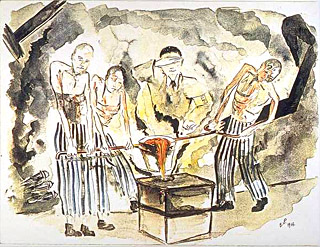
Forced labour governed over the life and death of a concentration camp prisoner. A prisoner working in the camp's administration had a privileged status compared to those working in the disciplinary kommando or the brickworks death camp and be faced with the brutal treatment of the SS combined with heavy labour.
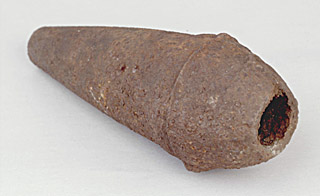
After 1945 the ex-prisoner Etienne van Ploeg painted this water colour, 'Work in the foundry'. In 1942 a foundry was constructed in the brickworks to produce grenades and prisoners were forced to produce iron grenade casings and anti-tank weapons.
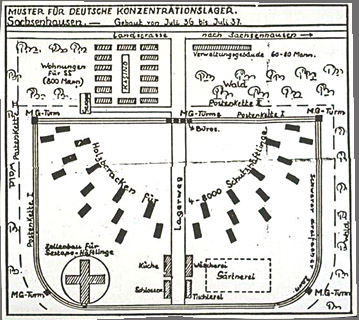
The two distinguishing characteristics of camp every day life were the total lack of freedom of movement and the control of a prisoner's time. The prisoners tried to take back these elementary necessities in every way they could. This map of the camp, by an unknown prisoner, illustrates well the lack of freedom of movement granted to prisoners and their limited knowledge of the borders and layout of the camp - the drawing differs greatly from the actual camp layout.
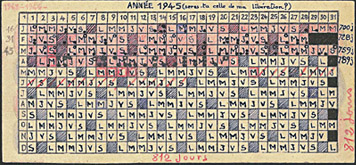
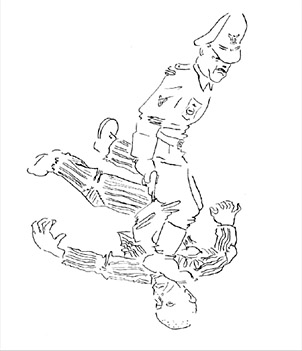
Every day life in the concentration camp was a perversion of what every day life should be like. It meant a prisoner could be - at any time, in any place - victimised, brutally mistreated, or killed.
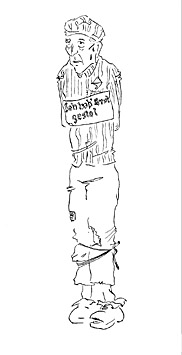
The ubiquitous deadly brutality of camp life, was expressed in this minimalist drawing by Albert Nicolaas, a Dutch prisoner, in 1944.
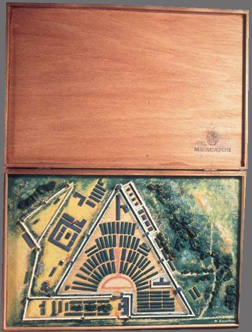
The experiences made by the concentration camp prisoners has changed their lives forever and they have had to learn to live with their memories in many different ways.
After 1945, Etienne van Ploeg, who was deported from Belgium to Sachsenhausen in 1942, constructed this model of the camp. Sachsenhausen, the 'ideal' concentration camp - in this miniature cigarette-case form, reduced the memories of the concentration camp and helped locked them inside the case, but it did not help to release them.

|
Prisoners |
|
|
Short Biographies |
|
 |
Edmund Braminski (*1917) Born in Kiel as the son of Polish parents, studied at the technical high school in Gdansk. Arrested in Poland in September 1939, only days after the invasion. Transported to Stuthof camp, arrived in Sachsenhausen in 1941. After the liberation returned to Gdansk and worked as an engineer in the Lenin shipyards. |
 |
Gustav Bürhner (*1887 - 1939) Born in Ulm/Tübingen. Became a Jehovah's witness in 1924, (illegalised 1933). Arrested many times during 1935/6. Sent to Sachsenhausen in 1939 where he died in unexplained circumstances five months later. |
 |
Lothar Erdmann (*1888 in Breslau - today Wroclaw, Poland, died 1941 in Sachsenhausen.) Was an officer in the first world war. Editor in chief of a union paper in Berlin from the mid 1920s until 1933. 1.9.1939 (start of the second world war) arrested and sent to Sachsenhausen. Died two weeks later due to mistreatment by the SS. |
 |
Werner Koch (*1910 in Wiesbaden - died 1994 in Ermlichheim). Theology student, member of the 'Bekennenden Kirche' - an opposition movement inside the Evangelical church. End of 1936 arrested because of his illegal activities and sent to Sachsenhausen. Released two years later. After 1945, pastor, active in the West German peace movement and in German-Jewish reconciliation. |
 |
Janina Krawczyk (*1919 in Vilnius, died 1999 in Warsaw). Arrested during the Warsaw uprisings in 1944. Together with his mother, brought to Germany for forced labour. Sent to Sachsenhausen sub-camp (AEG Heningsdorf). After the liberation, returned to Warsaw, worked as a teacher and later as an accountant. |
 |
Friedrich Lohmeyer (*1890 in Hannover, died 1945). Member of the SPD and an active unionist. Member of the illegal SPD group 'Sozialistische Front', arrested 1936. After the end of his prison sentence (1941) sent to Sachsenhausen by the Gestapo. Shortly before the end of the war, transported to Mauthausen. Nothing more is known of him. |
 |
Albert 'Ab' Nicolaas (*1917 in Leiden/Netherlands, died 1999, in Noordwyk a. Zee). Graphic artist. Protested against the occupation of his country. Attempted to flee to England. May 1944 he was betrayed, arrested and sent to Sachsenhausen. Remained there until liberation in 1945. In later life became a clown. |
 |
Sergej Owraschko (*1926 near Kiev, Ukraine). Transported to Germany in 1942 for forced labour. Arrested because of sabotage acts in 1943. Sent to Buchenwald, later to Riga concentration camp. Arrived in Sachsenhausen August 1943. Served in the red army after the end of the war. Later worked as an electromechanic in Kiev. |
 |
Richard Przystawik (*1906 in Hannover, died 1978 in Hannover). Casual labourer, previously convicted for theft. 1938 transported as an 'asocial' to Sachsenhausen. Status later changed to 'professional criminal'. Sent by the SS, a few months before the liberation to Mauthausen. Very little is known about his life after the liberation. |
 |
Walter Schwarze (*1914 in Leipzig, died 1999 in Leipzig). Barber. Arrested in 1940 because of his homosexuality. Sent to Sachsenhausen. Soon afterwards sent to Groß Rosen. 1944 released to serve in the armed forces. Held for 5 years in the Soviet Union as a prisoner of war. Kept his time as a concentration camp prisoner secret and only received compensation in 1994. |
 |
Willem Sel (*1921 in Mechelen/Belgium, died 1999 in Mechelen). Gymnast. Arrested 1941 as a member of the Monarchist Resistance Movement and brought to Germany. A 'night and fog' prisoner, sent to Sachsenhausen in 1943. 1944 arrived in Dachau. After the war, served with the Belgian foreign legion. Later worked in a school's administration. |
 |
Evzen Seycek (*1917 in Znajm/Mähren). Autumn 1939 took part in student protests against the German occupation of Prague. Arrested on 17 August 1939, together with 1200 other Czech students and transported to Sachsenhausen. Released April 1942. After the end of the war, completed his law studies and worked as a caricaturist and an editor. |
 |
Nikolai Subarew (*1922 in Moscow). Lieutenant in red army. May 1942 taken prisoner and forced to work in the Belgian coal mines. Escaped to the partisans. Re-arrested in 1944 and sent to Sachsenhausen. After the war, worked as an engineer for a car manufacturer in Moscow. |
 |
Per Svor (*1915 in Hornindal/Norway, died in 1985 in Oslo). Police officer in Oslo. Arrested beginning of 1942. Sent to the Grini prisoner camp after distributing anti-German flyers. Transported one year later to Sachsenhausen. After the end of the war, returned to Oslo and continued his work with the police. |
 |
Georges Tempier (*1921 in Caudec-les-Elbeuf/Normandy). Electrician for town council in Elbeuf. Active in resistance against German occupation. Arrested September 1942, sent to Sachsenhausen a few months later. Transported to Dachau. After the liberation, went back to Elbeuf and took up his old position. |
 |
Jakov Tsur (*1925 in Ostrava/Mähren as Kurt Cierer). Transported in 1944 together with 1000 further Czech Jews from Auschwitz-Birkenau to Schwarzheide, a sub-camp of Sachsenhausen. After the liberation, emigration to Palestine. Active during the war of independence. Worked as a teacher in a Kibbutz in Israel. |
 |
Heinz Wollmann (*1920 in Frankfurt/Oder). Arrested together with his father during the November pogrom on 9 November 1938 and sent to Sachsenhausen. Released February 1939. Family emigrated to Palestine. Worked for the Bayrischen Rundfunk in Israel. |
 |
Walter Winter (*1919 in Wittmund). German
Sinto. Deported to Auschwitz-Birkenau in March 1943. In July
1944 transported to Ravensbrück. Sent to Sachsenhausen in March
1945. Became a performer after the war. |
 |
Rudolf 'Rudi' Wunderlich (*1912 in Leipzig, died 1988 in East Berlin). Typesetter for the workers movement. Arrested because of work in the resistance. Imprisoned for four years. 1939 sent to Sachsenhausen. Escaped from sub-camp Lichtenberg in 1944. Active in the work on memorial and sites of remembrance in the GDR. |
 |
Erich Ziebart (*1910 in Landsberg/Warthe, died in 1974 in West Berlin). Imprisoned for various reasons until 1937. 1940 sent as a 'professional criminal' to Sachsenhausen. After the liberation from Mauthausen moved to West Berlin. Started a family. Worked as a painter. |